About RS SEO Solution
RS SEO Solution is an ISO-certified digital marketing company, providing complete SEO, SMO, PPC, website and software design & development services since 2004.

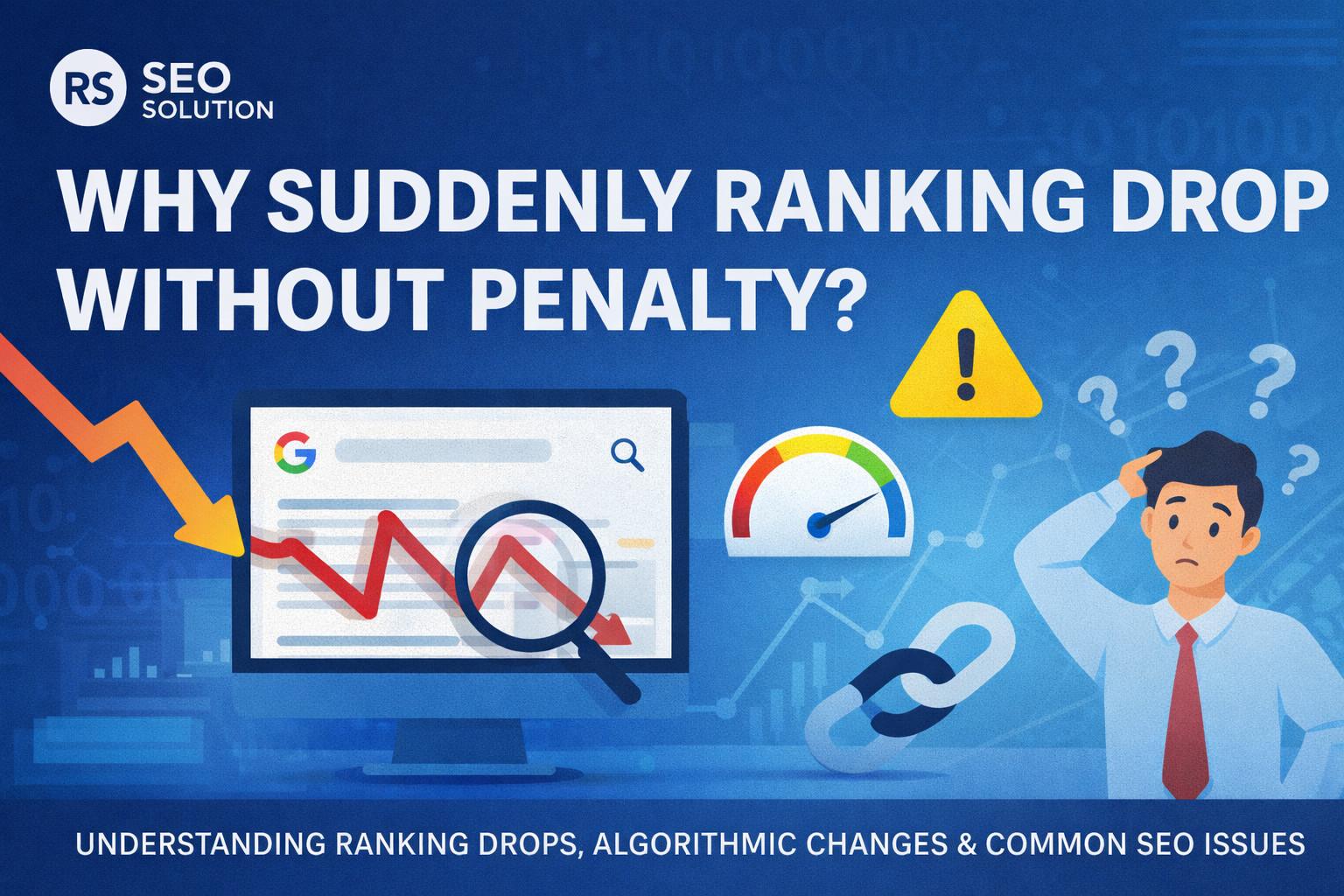
A sudden drop in Google rankings can be one of the most frustrating experiences for any website owner. Traffic declines overnight, keywords disappear from page one, and yet there is no manual action, no warning, and no penalty notification inside Google Search Console.
This situation is more common than most people realize.
Ranking drops without penalties are usually the result of algorithmic recalibration, not punishment. Google constantly adjusts how it evaluates content, links, intent, and trust. When these signals change, rankings shift—even for websites that have done nothing “wrong.”
In this blog, we explain the real SEO reasons behind sudden ranking drops, how to identify them, and what businesses should do to recover safely.
The first misconception to clear is this:
If there is no penalty, Google must be fine with the website.
That is not true.
Most ranking drops today happen because Google re-evaluates relative value, not because it penalizes a site. When competitors improve or when Google refines its ranking signals, your page may simply become less relevant in comparison.
This is why professional SEO services focus on continuous optimization rather than one-time fixes.
One of the biggest reasons rankings drop suddenly is silent algorithm updates.
Google no longer announces every significant change. Many updates roll out gradually and affect specific niches, keywords, or content types. These updates often target:
Content usefulness
Search intent matching
Link quality and relevance
Trust and authority signals
When this happens, rankings may decline even though:
There is no manual penalty
The website is technically healthy
The content still exists
This is normal in modern SEO.
Google has become extremely precise in understanding search intent.
If a keyword’s intent shifts over time and your page does not match it, rankings drop automatically.
For example:
Blog-style content targeting commercial keywords
Service pages ranking for informational queries
Old content not aligned with current user expectations
This is why regular website audit services are essential—to identify intent mismatches before traffic loss accelerates.
Content does not stay “good” forever.
Google constantly re-evaluates whether content:
Still answers the query clearly
Provides depth and originality
Demonstrates experience and understanding
Is better than competing pages
Thin updates, repetitive AI-generated content, or outdated information can all trigger ranking drops without any penalty.
Strong content marketing services focus on updating, improving, and expanding existing content—not just publishing new pages.
Another common cause is link devaluation, not link penalties.
Google may simply stop counting certain backlinks if:
They come from irrelevant niches
They lack contextual relevance
They were built in bulk without editorial value
In such cases, rankings fall because link equity weakens—not because the site is punished.
This is why sustainable link building services prioritize relevance, manual outreach, and contextual placement over volume.
SEO is not static. Even if your website stays the same, rankings can drop because others improved.
Competitors may:
Publish better content
Improve internal linking
Earn stronger backlinks
Enhance page experience
Google ranks comparatively, not absolutely. Staying still often means falling behind.
A comprehensive digital marketing services strategy ensures continuous improvement rather than reactive fixes.
Some technical problems reduce rankings quietly, without penalties, such as:
Slow page speed after design changes
Indexing issues caused by wrong tags
Broken internal links
Duplicate or cannibalized content
These issues rarely trigger penalties but gradually weaken rankings.
This is where periodic website audit services become critical for long-term stability.
Google closely observes how users interact with your pages.
If users:
Bounce quickly
Do not scroll
Return to search results
Google may interpret this as poor satisfaction—even if content is technically optimized.
Improving structure, readability, and clarity is just as important as keywords.
Many ranking drops become disasters because of wrong reactions, such as:
Deleting pages too quickly
Over-optimizing keywords
Disavowing good links unnecessarily
Publishing large volumes of low-quality content
SEO recovery requires analysis, not panic.
Experienced SEO professionals understand when to wait, when to improve, and when to restructure.
The safest recovery path focuses on:
Improving content quality and intent match
Strengthening internal linking
Auditing backlinks for relevance, not fear
Enhancing user experience and trust signals
A professional SEO services approach treats ranking drops as signals—not threats.
Most ranking drops today are not penalties. They are signals that Google’s understanding of quality, relevance, or intent has evolved.
Websites built on shortcuts suffer first. Websites built on strong fundamentals recover faster—and often come back stronger.
If rankings have dropped without explanation, the solution is not fear—it is strategy.
If your website has experienced sudden ranking loss without any penalty notice, it is the right time to review content, links, and intent alignment carefully. Early action prevents long-term traffic erosion.








Leave a comment
All fields marked with an asterisk (*) are required