About RS SEO Solution
RS SEO Solution is an ISO-certified digital marketing company, providing complete SEO, SMO, PPC, website and software design & development services since 2004.

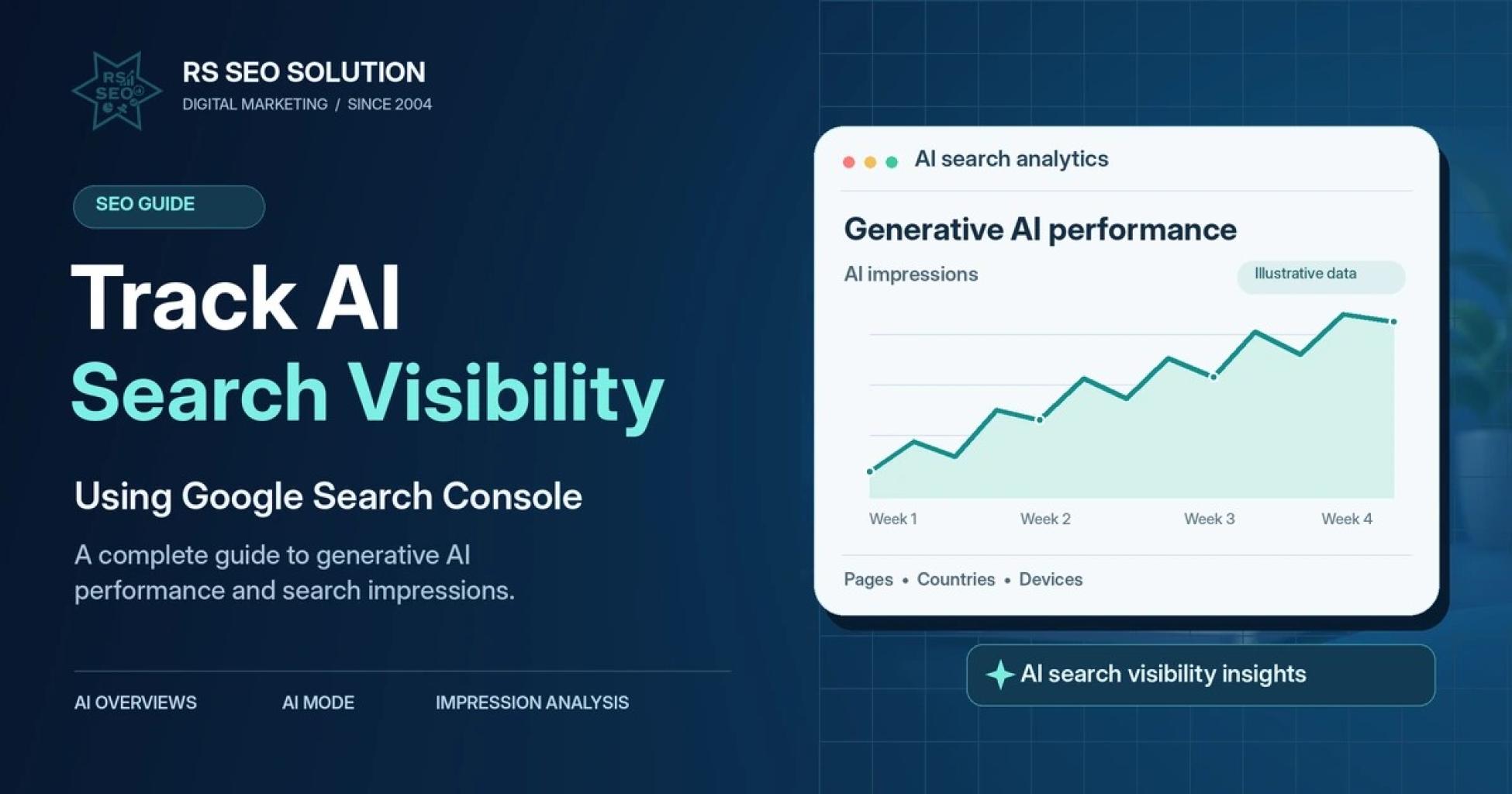
Discover how to track your website's visibility in Google's AI Overviews and AI Mode using the dedicated Generative AI Performance Report in Google Search Console. Learn how to interpret AI impressions, analyze page performance, identify optimization opportunities and combine AI search data with traditional SEO and website analytics for a more effective digital marketing strategy.
Search engine optimization is entering a new phase as artificial intelligence changes how people discover information, compare products and find solutions online. Traditional search results remain important, but users are increasingly interacting with AI-generated explanations, conversational search experiences and visually assisted search features.
For website owners, digital marketers and SEO professionals, these developments introduce an important question: how can you determine whether your website is appearing in AI-generated search results?
Previously, website owners had limited opportunities to measure their visibility specifically within Google's generative AI search features. Most performance data was incorporated into the broader search performance reports, making it difficult to evaluate AI search exposure independently.
On June 3, 2026, Google introduced dedicated Generative AI Performance Reports in Google Search Console. The reports became available worldwide on August 31, 2026, providing website owners with additional insights into how their content appears within AI-powered search experiences.
These developments create new opportunities for businesses to understand their online visibility, evaluate content performance and refine their search engine optimization strategies.
This comprehensive guide explains how to track AI search visibility using Google Search Console, interpret the available data and develop a practical approach to improving your website's performance in AI-powered search.
AI search visibility refers to the presence of a website, its content or its brand within search experiences that use artificial intelligence to generate responses and recommend information sources.
Traditional search engines primarily present lists of relevant web pages alongside other search features. AI-powered search experiences can combine information from multiple sources and present generated explanations with supporting links.
For example, a business owner searching for ways to improve website conversion rates may receive an AI-generated explanation covering website usability, content optimization, customer trust and performance measurement.
Within that explanation, Google may display links to relevant websites containing more detailed information.
If your website appears as one of those linked resources, it receives an opportunity to gain visibility through an AI-powered search experience.
However, AI search visibility is not necessarily the same as website traffic. A user may see your website referenced without clicking through to it.
This distinction is particularly important when interpreting AI search performance data. Visibility, engagement, website visits and commercial conversions represent different stages of the customer journey.
Before analyzing performance reports, website owners should understand the main generative AI experiences included in Google's search ecosystem.
AI Overviews provide generated summaries within Google Search results when Google determines that an AI-assisted explanation may be useful.
These summaries can help users understand complex topics, explore different options and discover relevant resources without immediately visiting several individual websites.
For instance, someone searching for the difference between traditional SEO and performance-based SEO may receive a summarized explanation supported by links to relevant educational resources.
Websites referenced within these summaries may receive additional exposure alongside ordinary search results.
AI Mode provides a more interactive search experience where users can ask detailed questions and continue exploring a subject through follow-up queries.
Instead of performing several separate searches, a user may ask an initial question, refine their requirements and request additional information within a conversational interface.
For example, someone researching digital marketing services could begin by asking how to promote a new business online. Subsequent questions might focus on marketing budgets, SEO services, advertising platforms and customer acquisition.
Different website resources may become relevant as the conversation develops.
This creates opportunities for businesses publishing useful content that addresses different customer questions and stages of the decision-making process.
Our existing guide on optimizing websites for Google's AI-powered search provides additional background about the evolution of AI search optimization.
The Generative AI Performance Report is a dedicated reporting feature that helps website owners monitor their exposure within supported generative AI experiences on Google Search.
Google announced separate reporting for Search and Discover, providing additional ways to understand how website content appears across these platforms.
The Search report currently covers AI Overviews and AI Mode.
Its principal measurement is impressions, allowing website owners to evaluate the frequency with which their website links appear in supported AI search features.
The introduction of this report is significant because businesses can now examine AI-related visibility through an official Google reporting tool rather than relying exclusively on manual searches or third-party estimates.
You can read Google's official announcement about generative AI performance reporting for further background.
Understanding the available data is essential before establishing performance targets.
The dedicated report provides several ways to examine AI search impressions.
| Reporting element | What it helps you understand |
|---|---|
| Impressions | Frequency of website link appearances in supported AI search features |
| Pages | Which website URLs receive AI search exposure |
| Countries | Geographic markets where impressions originate |
| Devices | Visibility across desktop computers, mobile devices and tablets |
| Dates | Changes in visibility over selected periods |
| Search type | Visibility associated with text-based and multimodal search |
Website owners can use these dimensions to identify content receiving exposure and investigate changes over time.
However, the dedicated AI report should not be confused with the broader Search Performance report.
At present, it does not independently provide AI-specific clicks, click-through rates, average ranking positions or a complete list of queries that generated AI references.
These limitations should be considered when evaluating campaign performance or presenting AI SEO reports to customers.
Website owners can use the following process to begin monitoring AI search visibility.
If you have not already configured Search Console, visit the Google Search Console website and sign in using your Google account.
Add your website as a property and complete the required ownership verification.
Google provides Domain and URL-prefix property options.
A Domain property can be particularly useful for businesses that want to monitor different protocols and subdomains collectively. A URL-prefix property may be appropriate when analyzing a specific website version or section.
Choose the property that matches your reporting requirements.
Before beginning detailed performance analysis, ensure that you are reviewing the correct website property.
After signing in, select your website property and locate the Generative AI Performance Report associated with Search.
You can also access the report through the link provided in Google's Generative AI Performance Report documentation.
The report displays available impression data for supported AI search experiences.
The interface may evolve as Google introduces additional reporting capabilities, so website owners should refer to the official documentation if menu names or report locations change.
Begin by selecting a meaningful reporting period.
For established websites, comparing the latest 28 days with the preceding 28 days can provide useful initial insights.
Websites receiving relatively few impressions may benefit from examining longer periods because short-term fluctuations can make individual daily results difficult to interpret.
You can also use weekly or monthly analysis to understand broader visibility trends.
When comparing performance, consider seasonal changes, website updates, marketing campaigns and changes in customer search behavior.
Select the Pages dimension to identify website URLs receiving impressions through AI search features.
This information can reveal which educational articles, service pages, product pages and other resources are appearing within supported AI experiences.
For example, a digital marketing company may discover that its detailed SEO guides receive substantially more AI exposure than its commercial service pages.
This could provide a useful starting point for content analysis.
Examine the characteristics of those pages, including the topics covered, information quality, examples, references and overall organization.
However, avoid assuming that a particular formatting choice or content feature caused the increased visibility. Search performance can be influenced by numerous factors.
Businesses serving international customers should examine the countries from which their AI search impressions originate.
A company targeting customers in the United States, United Kingdom and Australia may discover that its content receives different levels of AI exposure in each market.
These differences may reflect search demand, competition, content relevance, language preferences and the availability of particular search experiences.
Device-level analysis can also provide useful information.
For example, a website receiving substantial mobile AI search impressions should ensure that its landing pages deliver a satisfactory mobile experience.
Poor navigation, slow loading times or intrusive page elements may reduce the commercial value of visitors who arrive through those search features.
The report provides an export option that allows website owners to download available data for further analysis.
Regularly exporting reports can help businesses maintain historical records, compare performance and develop customized dashboards.
A digital marketing agency managing multiple websites can use these records to prepare consistent monthly reports for its customers.
Website owners should preserve the selected date range, filters and property information alongside exported data.
This helps ensure that future comparisons are made using equivalent reporting conditions.
Although Google completed the worldwide rollout of generative AI performance reporting in August 2026, some website owners may still find that the report is unavailable for their property.
According to Google's documentation, this generally occurs when the website has not received sufficient impressions within supported generative AI search features.
Another possible explanation is that the website has been excluded from Search generative AI features through its Search Console settings.
If the report is unavailable, consider reviewing the following areas:
Confirm that the correct Search Console property is selected.
Review the website's Search generative AI inclusion settings.
Check whether important website pages are indexed.
Investigate crawling restrictions and snippet-related directives.
Review whether existing content adequately addresses relevant search requirements.
The absence of a report does not automatically mean that Google has penalized your website or that it is permanently excluded from AI search results.
New websites and websites with limited search visibility may require additional time and meaningful optimization before receiving enough data.
Businesses experiencing wider indexing or search visibility issues can consider a professional website audit to identify underlying problems.
An impression is a measurement of search visibility rather than a confirmed website visit.
Within supported generative AI search experiences, impressions are recorded according to Google's applicable impression-counting rules.
For example, if a user's AI-powered search response displays a link to one of your website's educational guides, that appearance may contribute to your reported AI search impressions.
However, the user may not necessarily visit the website.
This makes impressions useful for understanding exposure, but insufficient for independently evaluating customer acquisition or sales.
Website owners should also understand why the total impressions displayed in a report may differ from the combined impressions of individual URLs.
Suppose two different pages from your website are referenced within the same generative AI search experience.
Depending on the selected reporting dimension, the property-level chart may record one impression for the website, while the individual page rows reflect separate page appearances.
Consequently, adding together every page-level impression count may produce a different result from the overall property total.
This does not necessarily indicate a reporting error.
When preparing reports, compare equivalent dimensions and aggregation methods to maintain consistency.
Google's official explanation of impressions, positions and clicks provides additional information about measurement rules.
Google Search Console's standard Search Performance report remains important for monitoring overall organic search performance.
The Generative AI Performance Report provides an additional perspective focused on AI search exposure.
| Measurement | Standard Search Performance | Generative AI Performance |
|---|---|---|
| Search impressions | Available | Available for supported AI features |
| Clicks | Available | Not separately available |
| Click-through rate | Available | Not separately available |
| Average position | Available | Not separately available |
| Search queries | Available, subject to reporting limitations | Not independently provided |
| Page-level analysis | Available | Available |
| Country-level analysis | Available | Available |
| Device-level analysis | Available | Available |
| Date comparison | Available | Available |
| Data export | Available | Available |
The two reports should be used together rather than treating them as entirely independent sources of search visibility.
AI search impressions are already included within the broader Web search performance data.
Therefore, businesses should not simply add the impressions from the dedicated AI report to their standard search impressions. Doing so can result in double-counting.
Similarly, dividing total organic clicks by AI search impressions would not produce an accurate AI-specific click-through rate.
Understanding these distinctions is essential for developing reliable SEO reporting practices.
Once sufficient data becomes available, businesses can begin evaluating how their website's AI exposure changes over time.
One straightforward approach is to compare impressions across equivalent reporting periods.
The following example illustrates how a website might monitor its AI search visibility.
| Month | AI search impressions | Observation |
|---|---|---|
| August | 1,200 | Initial monitoring baseline |
| September | 1,800 | Increased exposure |
| October | 2,700 | Continued visibility growth |
| November | 3,600 | Further improvement |
In this hypothetical example, AI impressions increased from 1,200 in August to 3,600 in November.
This represents a 200% increase compared with the initial reporting period.
The formula for calculating impression growth is:
AI impression growth (%) = [(Current impressions − Previous impressions) ÷ Previous impressions] × 100
When the previous period has zero impressions, percentage growth cannot be calculated using this formula. In such cases, report the absolute increase instead.
The example above is illustrative and does not represent actual performance data from RS SEO Solution or any customer website.
An increase in impressions can indicate expanding AI search exposure, but it does not independently establish that a particular SEO activity caused that growth.
Page-level analysis can help businesses identify which sections of their websites receive the greatest AI search exposure.
Consider the following hypothetical example of an SEO company's website.
| Website content | Monthly AI impressions |
|---|---|
| Complete on-page SEO guide | 1,250 |
| Digital marketing strategy guide | 950 |
| Technical SEO checklist | 780 |
| Link building guide | 620 |
| Performance-based SEO guide | 480 |
| Main SEO service page | 210 |
| Contact page | 35 |
Such a report may suggest that educational resources are receiving considerable exposure within generative AI search experiences.
However, commercial pages remain important because they help potential customers understand available services and make purchasing decisions.
A business should not abandon its service pages simply because educational resources receive more AI impressions.
Instead, consider how different pages work together.
A useful guide can introduce visitors to a subject, while contextual internal links help them discover relevant professional services when they require additional assistance.
Our guide explaining the importance of on-page SEO provides further guidance about developing useful website content and meaningful internal linking structures.
Measuring visibility is useful only when the resulting information supports better decisions.
Businesses should use performance data to identify opportunities for improvement rather than searching for shortcuts that supposedly guarantee inclusion in AI-generated answers.
As AI-powered search experiences develop, publishing generic summaries of information already available across numerous websites may provide limited additional value.
Businesses should consider what they can contribute through practical experience, research, useful examples and specialized knowledge.
For instance, a website development company could publish a detailed explanation of common ecommerce development problems, supported by original examples and recommendations from its professional experience.
This type of resource may be more useful to potential customers than an article containing only general definitions.
Our content marketing services can help businesses develop educational resources according to their audience requirements and marketing objectives.
AI-powered search often allows users to explore detailed questions and refine their requirements.
Website content should therefore address genuine customer concerns rather than concentrating exclusively on broad keywords.
An article explaining website auditing, for example, could address questions about indexing problems, technical errors, content duplication, page speed and prioritizing corrective actions.
These explanations should appear naturally within the content.
There is no need to create hundreds of separate pages for every possible variation of the same question.
When several questions belong to the same topic, a well-organized comprehensive guide may provide a more useful experience.
Reliable information is particularly important when visitors are making purchasing decisions or seeking professional guidance.
Businesses can improve the credibility of their resources by identifying authors where appropriate, explaining their experience, providing accurate references and supporting important claims.
A professional service provider can also publish original case studies, project descriptions and practical insights that reflect its actual work.
RS SEO Solution has been providing SEO, digital marketing and website development services since 2004. Our work portfolio and customer testimonials provide further information about our professional background.
Credibility should develop through verifiable information rather than unsupported marketing claims.
A website must satisfy important technical requirements before its content can become eligible for Google's generative AI search features.
Review crawling permissions, indexing status, canonical URLs and the availability of important textual content.
Also ensure that the website's Search generative AI settings permit inclusion if AI search visibility is one of your business objectives.
A technically optimized website should make its important information accessible without unnecessary barriers.
Businesses can use Search Console's URL Inspection tool to investigate indexing status and review Google's selected canonical URL for individual pages.
Professional complete SEO services can help businesses address technical, content and broader optimization requirements.
Internal links help connect educational resources with related content and commercial service pages.
For example, an article explaining AI search performance may naturally reference a detailed on-page optimization guide, a content marketing resource or a professional website audit service.
These connections help readers continue exploring relevant information.
Internal links should be meaningful and useful rather than excessively promotional.
A well-organized website architecture can also help search engines discover important resources and understand relationships between different pages.
Older articles can contain valuable information while also including outdated recommendations.
A website owner may discover that an established article receives significant AI search impressions despite containing references to discontinued technologies or older SEO practices.
Updating that article with accurate information, useful examples and current recommendations may improve its value to readers.
Avoid changing publication dates without making meaningful improvements.
Businesses should also avoid rewriting successful pages unnecessarily simply because they have been published for several years.
The objective is to maintain accuracy, relevance and usefulness.
The growth of AI-powered search has encouraged the development of numerous new optimization claims.
Some providers suggest that websites need special AI-specific files, excessive schema markup, fixed answer lengths or artificially generated brand mentions to appear within AI search experiences.
Google's official guidance does not establish these techniques as universal requirements for inclusion.
For Google's generative AI search features, established SEO principles remain fundamental.
Website owners should focus on producing genuinely useful content, maintaining technical accessibility and following search engine policies.
Google provides detailed recommendations in its guide to optimizing websites for generative AI features.
Website owners should understand that AI search inclusion and AI model training are separate considerations.
Google provides controls that allow website owners to manage how their content participates in different generative AI experiences.
The Search generative AI control available through Search Console allows website owners to manage whether their website's content and links participate in supported generative AI features in Google Search and Discover.
This is distinct from Google-Extended, which relates to certain other Google generative AI uses, including model training.
For example, a business may wish to continue appearing in Google Search and its AI-powered search experiences while restricting certain other uses of its content.
Different controls can support different objectives.
Website owners should avoid changing robots.txt files, snippet directives or AI inclusion settings without understanding their potential consequences.
| Website control | General purpose |
|---|---|
| Googlebot crawling controls | Manage Google's access to website resources |
| Search generative AI control | Manage inclusion in supported generative AI search experiences |
| Google-Extended | Manage certain other generative AI uses of website content |
| Noindex directive | Prevent a page from appearing in Google Search |
| Snippet controls | Manage how page content can be previewed or used in supported search features |
These controls should be configured according to the website owner's actual objectives.
Restricting content unnecessarily may reduce discovery opportunities, while allowing every use may not match the preferences of certain publishers.
Refer to Google's official documentation on controlling how content is used for generative AI before making changes.
Google Search Console primarily helps businesses understand how their websites perform within Google Search.
Google Analytics 4 provides additional information about what happens after visitors arrive at a website.
Combining these platforms can provide a broader perspective on marketing performance.
For example, a business may discover that AI search impressions are increasing for several educational guides.
Google Analytics can then help evaluate whether those landing pages are also receiving more organic visitors, generating meaningful engagement or contributing to customer inquiries.
However, these observations should be interpreted carefully.
An increase in organic traffic to a page receiving more AI impressions does not necessarily establish that the additional visits originated exclusively from AI Overviews or AI Mode.
Google Search traffic from different organic search features may be combined within analytics reporting.
Some AI-powered platforms may send visitors through identifiable referral domains.
Where referral information is available, businesses can examine traffic acquisition reports to identify visits associated with AI assistants or other discovery platforms.
Google Analytics custom reports and channel classifications can help organize this information.
However, referral information is not always transmitted consistently. Some visits may appear under other traffic categories or direct traffic.
Therefore, analytics reports may not capture every AI-generated website visit.
Businesses should avoid presenting incomplete referral data as a comprehensive measurement of all AI search traffic.
Google's documentation on using Search Console and Google Analytics together provides additional guidance for combining search visibility and website engagement information.
AI-powered search is not limited to written questions.
Users can increasingly search using photographs, screenshots, visual selections and combinations of images and text.
On September 24, 2026, Google announced the introduction of web multimodal search reporting in Search Console.
This development provides additional insights into website visibility associated with search experiences such as Google Lens, Circle to Search, uploaded images and supported browser-based image searches.
Businesses can use the available search type filters to examine text-based and multimodal search performance separately.
The multimodal reporting option is relevant to both the standard Search Performance report and the Generative AI Performance Report.
For ecommerce businesses, travel websites, retailers and other visually focused industries, these insights can provide useful opportunities to evaluate image-based discovery.
A furniture retailer, for instance, may discover that customers find its products through visual searches rather than conventional text queries.
Maintaining high-quality product images, descriptive alternative text, accurate product information and technically accessible image resources can support a better visual discovery experience.
Our ecommerce SEO services can help online retailers address product, category and broader search optimization requirements.
Additional information is available in Google's official multimodal search reporting announcement.
AI search monitoring should form part of a broader digital marketing measurement framework.
Different metrics help businesses evaluate different stages of customer discovery and engagement.
| Performance indicator | What it helps measure |
|---|---|
| Total AI search impressions | Overall exposure within supported Google AI search features |
| AI impressions by page | Visibility of individual website resources |
| AI impression growth | Changes in exposure across comparable periods |
| Country-level AI impressions | Geographic distribution of visibility |
| Multimodal AI impressions | Exposure associated with visual search experiences |
| Total organic search clicks | Overall traffic from Google Search |
| Organic landing page sessions | Website visits associated with organic acquisition |
| Qualified leads | Relevant potential customers generated through marketing |
| Organic conversions | Purchases, inquiries and other meaningful actions |
| Identifiable AI referral traffic | Trackable visits from external AI platforms where referral data is available |
Businesses should distinguish between metrics that directly measure AI exposure and those that measure broader organic search or website performance.
For example, an AI search impression is a direct visibility indicator, whereas total organic conversions reflect a wider range of customer acquisition activities.
This distinction helps prevent misleading performance claims.
A structured monthly reporting process can help website owners identify meaningful trends and establish practical optimization priorities.
Instead of collecting numerous metrics without a clear purpose, concentrate on information that supports business decisions.
The following reporting example illustrates how a business could organize its monthly analysis.
| Reporting metric | Previous month | Current month | Change |
|---|---|---|---|
| AI search impressions | 10,000 | 14,000 | +40% |
| Total Google Web search impressions | 100,000 | 120,000 | +20% |
| Total Google Web search clicks | 3,200 | 3,500 | +9.4% |
| Organic qualified leads | 80 | 95 | +18.8% |
| Identifiable AI-platform referral sessions | 120 | 180 | +50% |
These numbers are hypothetical and demonstrate reporting organization rather than actual website performance.
After reviewing the data, the business could examine which pages received increased AI impressions, investigate changes in geographic visibility and identify content requiring improvement.
It should also consider whether broader search traffic and lead generation are developing in a positive direction.
The table does not establish that AI search exposure caused the increase in qualified leads. Additional analysis would be necessary to investigate that relationship.
Businesses beginning to monitor AI search performance can benefit from establishing a structured initial plan.
Verify your Search Console and Google Analytics properties.
Review available AI search impressions, identify important landing pages and investigate whether technical restrictions may affect AI search inclusion.
Export initial performance data and record the reporting conditions.
The objective during this stage is to understand existing performance rather than immediately make extensive website changes.
Use page-level data and customer requirements to identify important optimization opportunities.
Improve outdated resources, develop meaningful explanations, correct technical issues and strengthen relevant internal links.
Consider creating original educational resources for topics where the website has useful expertise but limited existing coverage.
Document important changes so they can be considered during subsequent reporting.
Compare performance with the initial baseline.
Review impression growth, page-level exposure, country distribution, total organic traffic and meaningful business outcomes.
Determine which areas deserve additional investment and which changes require further evaluation.
Avoid drawing strong conclusions from small or temporary fluctuations.
This 90-day framework is an organizational recommendation, not a guaranteed timeframe for achieving improved AI search visibility.
As AI search reporting becomes more widely used, businesses should establish measurement practices that reflect the capabilities and limitations of available tools.
One common mistake is assuming that every AI impression represents a website visit. Another is treating increased AI visibility as automatic evidence of higher revenue.
Other practices to avoid include:
Adding AI impressions to overall search impressions and double-counting exposure.
Calculating AI-specific CTR using unrelated organic click data.
Assuming the dedicated AI report provides individual keyword rankings.
Comparing reporting periods with different filters or aggregation methods.
Drawing conclusions from a single manual AI search.
Treating third-party AI visibility estimates as exact Google performance data.
Purchasing services that promise guaranteed inclusion in AI-generated answers.
Replacing established SEO practices with unsupported AI optimization techniques.
Businesses should also review Google's documented reporting anomalies when investigating sudden unexplained changes.
A decline in reported impressions may sometimes relate to data collection issues rather than an actual reduction in website visibility.
For example, Google documented an AI impression reporting error affecting November 9–11, 2026. Checking the Search Console data anomalies page can help website owners identify such situations.
Reliable analysis requires understanding both the website's performance and the limitations of the measurement platform.
The introduction of dedicated AI search reporting does not eliminate the importance of conventional search engine optimization.
Businesses still need useful content, technically accessible websites, relevant search targeting and legitimate online promotion.
AI search should be considered another opportunity to connect potential customers with helpful resources.
A business may discover that its educational articles receive AI search exposure, while its commercial pages perform well in traditional search results. Its products may also benefit from visual search discovery and social media marketing.
These different opportunities can complement each other.
Our Search Everywhere Optimization guide explains how businesses can develop visibility across multiple online discovery platforms.
Similarly, our GEO optimization guide explores broader opportunities for brand discovery across evolving search experiences.
Rather than treating AI search optimization as a replacement for SEO, businesses should incorporate it into an integrated online marketing strategy.
Yes. Website owners can use Google Search Console and Google Analytics to monitor many important aspects of website performance without purchasing specialized SEO software.
The basic process involves reviewing reports, identifying important pages, monitoring changes and addressing suitable optimization opportunities.
However, interpreting performance data and implementing technical improvements may require additional knowledge.
Small business owners who prefer to manage SEO themselves may benefit from structured guidance rather than outsourcing every optimization task.
Our DIY SEO Solution provides a guided approach for businesses that want to learn and implement search engine optimization with professional support.
Businesses requiring more comprehensive assistance can also explore professional SEO, website auditing and content marketing services.
The appropriate approach depends on available resources, website complexity, competition and business objectives.
RS SEO Solution has been providing professional search engine optimization, digital marketing and website development services since 2004.
As search technologies continue to evolve, businesses need optimization strategies that consider both established SEO principles and emerging discovery opportunities.
Depending on your website requirements, our services can support activities such as:
Website auditing and technical SEO analysis.
Content optimization and educational resource development.
Search performance monitoring and keyword research.
Internal linking and website structure improvements.
Relevant external promotion and professional outreach.
Guided SEO learning for businesses managing their own optimization.
Our approach is to develop strategies according to individual website requirements rather than relying on a single optimization formula.
Businesses seeking coordinated marketing assistance can explore our complete digital marketing services.
Companies interested in connecting selected SEO service payments with measurable ranking achievements can also review our performance-based SEO services.
Performance-based keyword ranking arrangements should be distinguished from AI impression monitoring. AI search inclusion and visibility cannot be guaranteed.
AI search visibility describes the exposure of website content, links or brand information within AI-powered search experiences. It can help potential customers discover relevant businesses and information sources through generated responses.
Yes. Google's dedicated Generative AI Performance Report provides impression data for supported AI search features, including AI Overviews and AI Mode.
Google announced generative AI performance reports on June 3, 2026. The worldwide rollout was completed on August 31, 2026.
The dedicated Generative AI Performance Report currently focuses on impressions. Clicks from supported Google AI search experiences contribute to broader Search Performance reporting, but the dedicated AI report does not separately provide AI-specific click totals.
Not accurately using the dedicated AI impressions report alone. A valid AI-specific click-through rate requires corresponding AI-specific click data measured under equivalent reporting conditions.
The dedicated AI report does not currently provide a separate query dimension showing the exact search terms responsible for individual AI impressions.
Your website may not have received sufficient eligible impressions. Review the selected property, Search generative AI settings, indexing status and other relevant website accessibility requirements.
No special AI-specific schema markup is required for inclusion in Google's generative AI search features. Relevant structured data may still support ordinary search functionality where appropriate.
No. Impressions measure exposure rather than visits. Users may see website references without clicking them, and additional visibility does not automatically result in more sales.
Google Analytics may identify visits from external AI platforms when recognizable referral information is transmitted. However, not all AI-generated visits can necessarily be identified or attributed accurately.
AI search introduces additional discovery experiences and reporting considerations, but Google's foundational SEO recommendations remain important. Helpful content, technical accessibility and accurate information continue to support search visibility.
Multimodal search reporting helps website owners examine performance associated with searches that use visual input, including supported Google Lens, Circle to Search and image-upload experiences.
Not by itself. Google-Extended and Search generative AI inclusion controls serve different purposes. Website owners should review Google's current documentation before configuring these settings.
A monthly review is a practical starting point for most businesses. Larger websites or businesses conducting substantial optimization campaigns may benefit from more frequent monitoring.
No SEO company controls whether Google includes particular websites in generated search responses. Professional optimization can improve website quality and eligibility, but inclusion and exposure cannot be guaranteed.
The introduction of generative AI performance reporting in Google Search Console represents an important development in the evolution of search engine optimization.
Website owners now have access to dedicated information about how their content appears within supported AI-powered search experiences, creating new opportunities for performance analysis and content improvement.
However, successful AI search monitoring requires an accurate understanding of the available data.
AI impressions should be treated as visibility measurements rather than confirmed website visits or commercial conversions. Standard Search Performance reports, Google Analytics and other business data remain essential for evaluating overall marketing effectiveness.
Businesses should concentrate on publishing original resources, maintaining technical accessibility, understanding customer requirements and improving their websites through meaningful optimization.
Instead of relying on unsupported shortcuts or guaranteed AI visibility claims, develop a structured approach that combines established SEO practices with evolving search technologies.
Whether you prefer to manage your website's optimization independently or require professional assistance, understanding AI search performance can help you make more informed digital marketing decisions.
If you are looking to improve your website's organic search visibility, analyze technical SEO problems or develop a comprehensive strategy for traditional and AI-powered search, contact RS SEO Solution to discuss your requirements and explore suitable professional SEO solutions.








Leave a comment
All fields marked with an asterisk (*) are required